

Tag Archive for: infrastructure improvements

Industrial assets built throughout Florida between 2015 and 2022 have led to record-setting development totals never before seen in the state’s history.

One key measurement of the success of new supply is property stabilization rates. (Assets are considered stabilized once 90 percent of the building is leased.) Over the past five years, Jacksonville and Miami ranked as the top two markets in Florida to stabilize in the shortest period of time. Jacksonville leads the state with an average of 1.6 quarters to stabilize, while Miami trails shortly behind, averaging 2.1 quarters. The Tampa market rounded out the top three with an average of 2.7 quarters.

Florida began preparing for the industrial boom over a decade ago, adding infrastructure growth projects at the ports and rail transportation in preparation for the expansion of the Panama Canal. That, coupled with the unforeseen and expedited rise of e-commerce as a result of the global pandemic starting in 2020, pushed industrial into the spotlight of the commercial real estate industry. Since then, Florida’s robust population growth, coupled with its pro-business and low tax policies, have catapulted record demand, booming development, and limited supply of available industrial space in key markets.

The Buildup Since 2015

Industrial developers have taken advantage of the strong economic benefits. Statewide the leaders in this category include Prologis, McCraney Properties and Flagler Real Estate. Since 2015, Prologis has delivered 36 buildings totaling 7.9 million square feet — the most in the state. Primarily focused on South Florida, the company has achieved 24 deliveries totaling 4.5 million square feet in the region.

Prologis also leads in total acquisitions of industrial properties (in addition to its acquisition of Duke Realty’s portfolio), with Blackstone and McCraney trailing closely behind. Foundry Commercial is another active buyer, with a major focus on the Orlando market. With more 2023 deliveries arriving in the coming months, these buyers will likely continue to scoop properties off the market to add to their investment portfolios.

Florida construction activity also remained strong at the close of 2022, with more than 23.1 million square feet of industrial assets underway throughout the key markets, of which approximately 31 percent is already preleased. The Miami market leads the charge with fully half of its 4.2 million square feet under construction already preleased.

At the end of the fourth quarter of 2022, all Florida markets maintained their high occupancy rates with an average of only 3 percent vacancy across the state. The high level of leasing demand positions Florida as a top contender among the Southeast. Remaining available space under construction continues to be a necessity as limited supply persists and magnifies the need for a large quantity of industrial space to enter the construction pipeline.

Expectations For 2023

Following the records set during the industrial boom, we are entering a more leveled-off market starting in 2023. These slowdowns are no cause for concern and are a natural correction to the abnormal market activity we have experienced over the past few years. Looking ahead, we can expect more leveled-off activity across the state of Florida with slight growth happening in markets such as Miami and Jacksonville.

Jacksonville has been on an upward trend for many years, and the start of 2023 indicates that it should continue. The market is projected to deliver over 8 million square feet of industrial space in 2023, and the current tenant demand indicates that the majority of the new space will be full by the end of the year.  Rental rates will most likely increase as a result, but still be the cheapest option in Florida, making the northeast part of Florida an attractive option.

In Central Florida, tenant demand remains robust despite economic headwinds. Over 14 million square feet of demand from tenants is being tracked, which far exceeds the available supply, indicating that rental rates are likely to rise there as well.

Finally, in the South Florida metro area, scarcity of well-located developable industrial land, strong lease absorption and rent growth statistics, as well as the continued influx of new residents to the state and region, will help ensure the further stabilization and healthy growth of the industrial market.


Source: Commercial Observer
port everglades_145015725_s 770x320

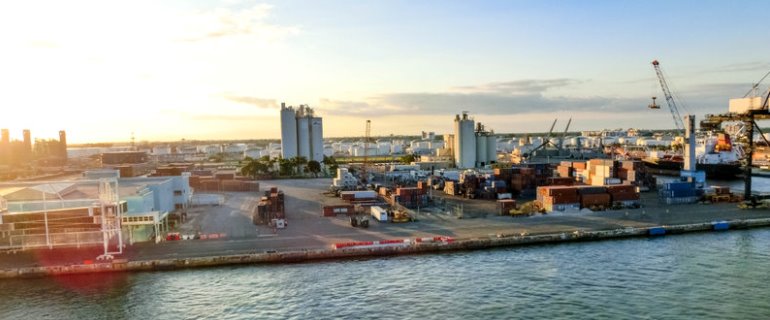
WSP USA’s extensive experience with maritime structures has helped facilitate a critical expansion at Florida’s leading container port – while at the same time mitigating the project’s environmental impacts.

The Turning Notch Expansion aims to increase berthing space to accommodate larger modern container ships at Port Everglades. The Port handles more than 1 million 20-foot-equivalent units of cargo volume and serves as a gateway to Latin America, the Caribbean, Europe and Asia.

The program is an important component of the Port Everglades masterplan which identified this project to double the containerized cargo capacity of the existing port over the next decade, and to allow for berthing of super post-Panamax vessels.

To accommodate these larger ships, the port initiated the redevelopment of 25 acres of container yard and berthing apron space at its Southport Turning Notch. WSP was hired by Broward County to provide civil and structural engineering design services and serve as a specialty consultant for port-related design issues for the $500 million project, which is scheduled for completion in the summer of 2023.

The project is being delivered via a general contractor/construction manager, where the contractor is selected and engaged early in the design phase of the project to help mitigate risk.

Infrastructure Improvements

The scope includes excavation of three million cubic yards of material to create a 42-foot-deep turnaround area for cargo ships, along with five additional berths, including a Super Post-Panamax berth. Marine and landside improvements entailed 5,000 feet of seawall/wharf and marine and utility infrastructure, including a stormwater drainage system comprising 7,200 feet of pipe and 1,900 feet of exfiltration trenches.

The project also consists of landside infrastructure improvements to support the acquisition of six additional Super Post-Panamax gantry cranes in Southport along Berths 31 and 32 as well as Berth 30. Additionally, the existing 100-foot gauge rails along Berth 30 project are also being extended westward to the limits of the new Southport Turning Notch Extension.

WSP’s scope for the expansion required the design of nearly one mile of new steel bulkhead wall, evaluation of an existing steel bulkhead wall, removal of several acres of land, container yard upgrades and improvements and fender and mooring hardware upgrades. Furthermore, Berth 30 – which is 970 feet long and located within the notch – has to remain operational during construction.

“WSP worked closely with the owner and the contractor team to execute the multi—faceted and highly publicized project in a timely manner within an operational terminal,” said Kosal Krishnan, WSP national maritime leader.

WSP also deployed construction administration staff and provided round the clock technical services in support of construction.

Marine Habitat Mitigation

To offset the project’s environmental impacts, WSP developed environmental mitigation to satisfy permit requirements. In the project’s first stage, the team restored approximately 16.5 acres of upland mangrove marsh by excavating fill to re-contour the marsh, then planting 70,000 Florida-native, nursery-grown mangrove and wetland transition buffer plants.

The mitigation design created additional mangrove habitat through the construction of riprap planters and restored the shoreline of an existing manatee nursery area by removing existing nuisance exotic vegetation and reconfiguring the eroded shore. For reef mitigation, 814 corals were relocated to create three acres of artificial reef habitat for natural recruitment, ultimately replacing nearly 15 acres of existing hard-bottom reef habitat.

“WSP monitors the mangrove and reef habitat on a quarterly basis to document the success of these mitigation areas, and ongoing observations of wildlife have revealed wading birds, shorebirds and other highly mobile avian species,” Krishnan said.

Located within the cities of Fort Lauderdale, Hollywood and Dania Beach, Port Everglades is in the heart of one of the world’s largest consumer regions, with a constant flow of approximately 110 million visitors statewide and six million residents within an 80-mile radius. The port has direct access to the interstate highway system and the Florida East Coast Railway’s 43-acre intermodal container transfer facility and is closer to the Atlantic Shipping Lanes than any other Southeastern U.S. port.


Source: wsp