Tag Archive for: community redevelopment agency

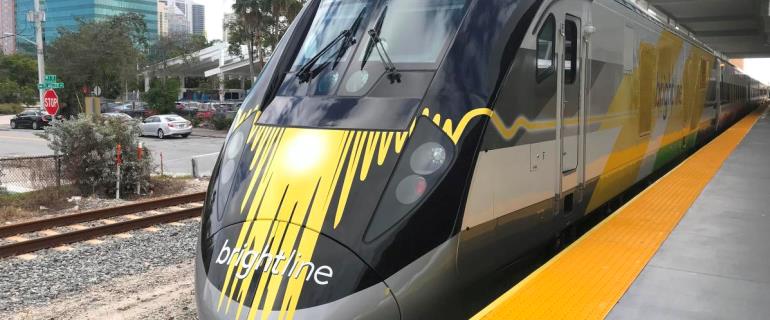
brightline train 770x320

Downtown Boca Raton’s new Brightline station is being positioned as catalyst for growth — with the goal of building up a transit-oriented destination that will offer more new housing, stores and plenty more.

The Boca Raton station, at 101 NW 4th St., and a station in Aventura each opened in December last year, increasing the number of South Florida stations from three to five. Resembling the babies of the family, the newer stations are expected to mimic their sibling stations, which opened in 2018 in West Palm Beach, Fort Lauderdale and Miami. The older stations already have drawn growth and redevelopment around them.

“The Brightline is hugely instrumental into the growth of Boca Raton because now you can have somebody who’s working down in Miami who can live ‘in the suburbs’ up here,” said Scott Gerow, the executive director of luxury sales at the Cotilla-Beresh-Gerow Luxury Team at Compass. “Now it makes it more of a commutable region, like Long Island or Connecticut would be to Manhattan.”

Jenni Morejon, the president and CEO of the Fort Lauderdale Downtown Development Authority, added, “Every city that has a Brightline station either today, or ultimately a commuter rail station in the future, is going to see tremendous mixed-use development because it is truly a driver for investment.”

Here’s a look at how growth is bound to come near Boca’s Brightline station.

A 13-Story Building Proposed

Evidence of a future defined by development already may be making an appearance: A proposal, recently filed with the city, calls for a 13-story multi-use project called Modera Boca Raton that would feature a 358-unit apartment building near the station.

The plan calls for about 6,500 square feet of retail space, as well as nearly 490 parking spots. The planned amenities would include a clubhouse, fitness center, courtyard, rooftop pool and sundeck.

The project would be located immediately south of the Brightline station specifically west of Northwest Second Avenue, east of Northwest First Avenue, south of Northwest Fourth Street, and north of Northwest Third Street. The Boca Raton Public Library sits nearby.

A Consultant’s Help

“The city is seeking a consultant to guide the creation of the transit-orientated development that the area currently lacks,” said Marc Wigder, chair of the Boca Raton Community Redevelopment Agency. “Such a consultant would help the city design a sustainable, transit-oriented district with a mixture of uses that would highlight the transit hub, would highlight the government center hub, and would highlight the ability to not be so vehicular dominated. That’s kind of what you want, transit-oriented development that enables neighborhood feelings without vehicular dependency.”

The aim is to achieve what Wigder said is called an “internal capture,” wherein people don’t have to drive everywhere, underscoring the live, work, play concept he and other members of the council have continued to push for in Boca Raton’s downtown scape. Public input will also play a role, Wigder said, and will be gathered over the next several months.

Other Stations’ Successes

Thriving examples of growth around Brightline stations exist both north and south of Boca’s station. Take Fort Lauderdale, for example: Since its station opened in 2018, the city’s downtown population has seen an increase of more than 10,000 people and 5,000 new rental units, according to data from the Fort Lauderdale Downtown Development Authority.

In November, the Broward County Commission voted to build a new government center next to the Fort Lauderdale station, bolstering the potential growth there.

“A transit-oriented development takes care of any and all needs of the residents or employees living in that area,” said Morejon, the Downtown Development Authority’s president. “And while Fort Lauderdale experiences a similar issue to Boca Raton in terms of finding land to develop, a solution to that is developing more efficiently. You really have to go vertical. A lot of it is about redeveloping properties that already have existing development. And that’s not a bad thing because it makes for more compact cities, more walkable cities, cities that have a lot more amenities in close proximity.”


Source: SunSentinel

heavy machinery silhouette against sunset_canstockphoto22611529 770x320

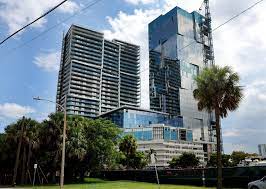
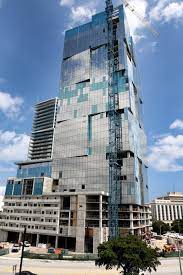
Two massive towers are rising in West Palm Beach, reaching 426 feet high to clutch the tile for the city’s tallest high-rises.

They’re just the latest sign of the expansive growth as the downtown lures more businesses and residents.

The 30-story mixed-use complex, titled One West Palm, will contain 326 luxury residential units, 200,000 square feet of Class A office space, a hotel and a long list of amenities, including a fitness club, spa, movie theater and indoor tennis courts.

“These aren’t just the tallest,” One West Palm developer Jeff Greene said. “They’re certainly going to be the iconic landmark buildings in the skyline of West Palm Beach.”

One West Palm sits at 550 N. Quadrille Blvd. in West Palm Beach on Sept. 15. Developer Jeff Greene said the project will be completed some time next year. (PHOTO CREDIT: Carline Jean/South Florida Sun Sentinel)

Residing at 550 N. Quadrille Boulevard, the 426-foot behemoths could fit the length of nearly one-and-half American football fields. They may be the buildings closest to the sky in West Palm Beach, but the project is certainly not the only one in the works.

The “Wall Street of the South” has become a magnet for developers, especially as people migrate from the cities south of it and move from states in the Northeastern United States.

‘The Most Exciting Thing ’

Construction on One West Palm began more than four years ago, and delays pushed completion to 2024, Greene said. But his excitement for the project remains, especially as it will now join other newly developed current and future projects.

“We started out with a kind of out-of-the-way location that really was across from a bunch of boarded-up buildings in Palm Beach,” Greene said. “And now we’re sitting kind of dead center in the middle of the most exciting thing happening in all of South Florida. So it’s really an exciting time for our project.”

The AKA Hotel is at 695 S Olive Ave. in West Palm Beach, seen here on Sept. 15. This luxury hotel opened last year. (PHOTO CREDIT: Carline Jean/South Florida Sun Sentinel)

Greene said his vision was to create something the city did not yet have. While One West Palm will tout the title of highest buildings in the city, the surge of development in the area has produced several projects, some of which were recently completed, some of which are under construction and some of which were recently approved.

Among those projects are:

  • 360 Rosemary, a nearly 300,000-square-foot office building at 360 S. Rosemary Ave., Suite 1100. This project was completed in 2021.
  • AKA Hotel, a luxury hotel at 695 S. Olive Ave., recently opened last year.
  • One Flagler, a 25-floor Class A-office building with luxury amenities at 154 Lakeview Ave., is under construction.
  • Olara, a luxury waterfront residence at 1919 N. Flagler Drive, is under construction and expected to open in the next few years.
  • NORA, a mixed-use district featuring casual to high-end dining, desserts, coffee shops, boutique fitness spots and retail, will open its first phase in 2024. Its first food and fitness tenants were recently announced.
  • Transit Village, a mixed-use transit-oriented development with residential units planned for 150 Clearwater Drive and 203 S. Tamarind Ave.
  • 515 Fern, a 25-floor mixed-use building expected to become the largest office building in downtown West Palm Beach at 515 Fern St.

Unlocking A Formula

“Those years of great planning and foresight and investment into the city are now bearing fruit by the private sector recognizing that this is a great place,” said Christopher Roog, the executive director for West Palm Beach’s Community Redevelopment Agency. “The growth is occurring in a managed but high-quality way that is benefiting the residents.”

Roog said the city has unlocked a formula for creating places people want to work and live, leaning into the ever-popular ‘Live, Work, Play’ concept so many other cities, such as Boca Raton, are adopting.

“We’re intentionally building our built environment, like our streets and our sidewalks, to make them so comfortable and so inviting that it makes it very easy for that ‘Live, Work, Play’ concept to happen,” Roog said.

“More than 10,000 people now live in downtown West Palm Beach, and even four years ago, the population didn’t hit anywhere close to that,” said Diane G. Papadakos, the city’s director of communications.

“It doesn’t matter where you come from, you can live in the city of West Palm Beach and thrive here,” Roog said.

Growing As A Destination

The flocks of developers, Northeasterners and companies moving to the area is accelerating West Palm’s trajectory, said Jaime Sturgis, the CEO and founder of Native Realty, the real estate firm behind the AKA Hotel and other West Palm Beach projects.

“When a number of these really large funds or private equity groups or even development companies have moved down here, they want to build things that are in their backyard,” Sturgis said. “With all of that wealth that’s migrated down here, there’s also been a tremendous demand to build projects to support the people that are coming. A company coming from Manhattan, for example, is accustomed to state-of-the-art facilities and rental properties to support the company’s workforce.”

For the past 10 to 15 years, West Palm seemingly stalled behind cities such as Miami in “urban core development,” Sturgis said, meaning a lack of construction, new office buildings, retail and multifamily residences.

“The urbanization of formerly industrial neighborhoods, which we’ve seen take off on a massive scale in both Miami and Fort Lauderdale, right through Wynwood and through Flagler Village, has been very successful,” Sturgis said. “And now West Palm is doing that with Nora, which I think is phenomenal. … It really starts to become like a true urban core.”

While not entirely new, the Brightline station in West Palm affords more flexibility for people who live in the city but work elsewhere, Sturgis said. And with more than $70 million in Tri-Rail funds for updated coaches, accessible transportation continues to play an integral role in not only taking people to West Palm Beach to enjoy a night on Clematis Street or a day walking in The Square, but keeping them there and turning them into new residents, too.

Rapid growth, especially when coupled with the arrival of large, successful businesses to an area still coming into its own, could create an environment where standalone spots are swallowed whole by chains. But Sturgis does not feel this threat looms over West Palm Beach or anywhere in South Florida for that matter as he watches communities rally around small businesses.

“We’re still seeing a desire for local and regional tenants,” Sturgis said. “A local coffee shop, or the owner of the local bakery where the husband and wife are working there each day, that sort of thing.”

‘Unique Environment’

Clusters of new buildings popping up in a city are not enough to support people’s desire to visit or stay, no matter how nice they may be. Take it from Jordan Rathlev, a senior vice president of Related Southeast, the real estate company behind West Palm’s 360 Rosemary, One Flagler and 515 Fern.

The ability to cultivate a desired lifestyle, whether that revolves around golfing, beach access, walkable downtowns, outdoor restaurants or all of the above, is an important factor in the decision to move, Rathlev said, which is why Related considers those aspects when deciding where and how they want to move forward with particular developments.

“We start to recognize if people want to come and be successful in South Florida, there’s a lot of critical infrastructure pieces that we’re looking to address because they come to these cities, they expect some of the same amenity base and offering that you would have in some of the other world class cities around the country,” Rathlev said.

West Palm’s planning department, which Rathlev said is “very progressive” in encouraging a variety of architectural types, helps achieve that goal. But the city also remains sensible. Developers aren’t constructing buildings 100 stories in the air, he said.

“I don’t think you will ever see West Palm evolve to the scale and density of a Miami and New York, and frankly, I don’t think we personally want it to,” Rathlev said.


Source: SunSentinel