
Tag Archive for: job creation

manufacturing 770x320

The U.S. is at the cusp of a manufacturing supercycle that could reshape the global investment landscape and greatly impact the real estate industry.

This manufacturing resurgence gained momentum with the “America first” emphasis and 2018 tariffs on Chinese goods. The Biden administration continued restricting capital inflows to China, which further encouraged bringing supply chains to the U.S. This drive is bolstered by legislative acts that provide nearly $2 trillion in domestic investment and incentives: the U.S. Inflation Reduction Act for clean energy, the $280 billion CHIPS and Science Act for semiconductor production and the $1 trillion Infrastructure Investment and Jobs Act for sustainable infrastructure.

Consequently, U.S. manufacturing construction outlays have surged to $196.1 billion as of July. The government’s initiatives to bolster domestic manufacturing have unleashed a wave of investment that could reshape supply chains during the next decade and create a significant tailwind for the real estate sector.

Manufacturing Supercycle And Regional Beneficiaries

From my perspective, the American South could be a primary beneficiary of manufacturing investments. Texas, in particular, has received a disproportionate share of investment, with firms such as Samsung, Texas Instruments (paywall) and Tesla already commencing expansion plans that are expected to create thousands of new jobs during the coming years.

The Laredo, Texas, border gateway is a primary point for goods shipments coming to the U.S., with a reported 37% of truck container crossings and 46% of rail containers entering in 2021 through that corridor. Additionally, Laredo registered a 12% year-over-year increase in commerce in 2023. From my view, this heavy traffic has helped increase the demand for industrial space in the central Texas corridor, including San Antonio and Austin.

Xebec, a developer focused on industrial properties, revealed plans for a “3,300-acre logistics and manufacturing center” on a 32,000-acre site northeast of Austin, according to the Dallas Morning News. This development is one example of many seeking to fill the demand for industrial and residential space near multi-billion-dollar projects like Samsung’s chip factory in Taylor and Tesla’s Gigafactory. The impact of these developments will be felt across the Austin-San Antonio corridor and could generate significant economic output and position the region as a hub for advanced manufacturing and technology.

Florida is also poised to benefit from a surge in advanced manufacturing investment. With the NeoCity district positioning Orlando as one of the top cities for STEM talent in the U.S., the state’s prospects are promising.

Moreover, it is expected the region will see a substantial economic boost from several major infrastructure and technology projects currently underway. Among these is Brightline‘s high-speed rail initiative, which links cities like Miami and West Palm Beach to Orlando. This connectivity will enhance commuter access to the Orlando market, catalyzing growth in central Florida. A press release by the company said the rail project generated 10,000 new jobs during its construction phase. Given the current growth trajectory, Florida’s population is estimated to rise by 3.2 million by 2030, according to the Florida Apartment Association. To accommodate this surge, the state will require over 570,000 new housing units, the FAA also said.

Elsewhere in the south, companies like Toyota, Hyundai, BMW and Albemarle are investing billions of dollars in what’s been called the new “Battery Belt.” The auto manufacturing industry has expanded from the traditional markets in the Midwest, which could lead to the creation of tens of thousands of jobs in states like Georgia, Tennessee and North and South Carolina.

Beyond the U.S., Mexico stands to benefit from the regionalization of supply chains, given the existing United States-Mexico-Canada Agreement, proximity to U.S. population hubs, affordable labor and ample land.

What This Means For The Real Estate Sector

The manufacturing sector has one of the highest job multipliers, as a manufacturing plant typically fosters demand for suppliers, transportation services and maintenance providers. From my perspective, one of the ripple effects of the revival in domestic manufacturing will be an increased demand for residential real estate throughout the southern states with proximity to ports. Investments in clean energy, infrastructure and semiconductor production will stimulate large-scale job creation throughout these states, particularly in higher-wage sectors.

Based on data from the U.S. Bureau of Labor Statistics, the Dallas-Fort Worth metro is on a trajectory to add 150,000 to 200,000 jobs annually during the coming years, which would be an increase of roughly 4% per year and almost twice the pace of job creation before the pandemic. The conventional theory assumes that one new housing unit is needed for every 1.5 new jobs created. Permits authorized in 2022 for the DFW metro only amounted to about 76,000, creating an annual deficit of roughly 23,000 to 56,000 housing units. This comes at a time when the U.S. already faces a nationwide housing shortage and underscores the need to develop new housing units to meet excess demand.

As the nation intensifies its commitment to domestic manufacturing and the states in the Southeast attract vast industrial and residential investments, there will be significant demand for new housing and industrial space that will not be met by current construction projections and permitted developments. It is important for policymakers, real estate developers and investors to focus on these areas of growth and plan ahead in order to avoid rapidly rising rents and housing costs.

Additionally, real estate developers and investors should consider how they can capitalize on the upcoming capital investment wave. Housing developments generally take two to four years to materialize from inception. Investors and developers should pay attention to the mentioned growth corridors. Additionally, it is critical that developers engage with local municipalities to stay informed on upcoming manufacturing and infrastructure investments to ensure there is sufficient housing available when these investments come to fruition.


Source: Forbes

 

green pasture with palm trees_canstockphoto16651364 770x320

A little chest thumping never hurt anybody — especially when business is sizzling during inflationary times.

The economic development agency for Palm Beach County made a splash in Times Square in New York City with some targeted advertising. (PHOTO CREDIT: Business Development Board of Palm Beach CountY)

In a case of “strike while the iron is hot,” or perhaps before it turns cold, the Business Development Board of Palm Beach County just took its decade-old “Wall Street South” campaign to midtown Manhattan with the purchase of one-day ads on giant electronic billboards in Times Square and nearby neighborhoods.

“Wall Street South. Head for Palm Beach, Florida,” said one. “Wall Street South. Your Future Is Bright in Palm Beach, FL.” said another.

Fort Lauderdale’s Downtown Development Authority, meanwhile, is circulating a report declaring that its central business district and Flagler Village are generating as much economic activity as Port Everglades and Fort Lauderdale-Hollywood International Airport. For this, think about amounts for each entity that are north of $30 billion a year.

The heads of both agencies are advocates of maintaining hard-earned momentum in a highly competitive economic development game made more difficult by stubborn rising costs for businesses and households.

Kelly Smallridge, president and CEO of the development board, said in an interview that her nonprofit agency caught a deal that was hard to resist: Color ads in three locations for $20,000 — not only for this past Wednesday, but for the forthcoming New Year’s Eve celebration as well.

“This is probably the boldest strategy from an advertising perspective  we’ve engaged in anywhere in Manhattan,” Smallridge said. “I can’t image the hype that’s going to take place when it airs on New Year’s Eve.”

Development board representatives have been visiting New York for years touting the county’s “Wall Street South” campaign, which is designed to persuade executives from financial firms to locate or relocate offices, including headquarters, in Palm Beach County.

Smallridge said her agency was approached by a billboard ad firm and offered a discount rate designed for nonprofit agencies.

“We got very lucky and took advantage of it,” Smallridge said. “We could no way afford the real cost. They approached us to see if we wanted to buy it. They never would have had us on their radar had not been such a big story already. Every time you go to Manhattan, people say, ‘it’s not if we will move, but when.’”

She said the ads appeared at the Times Square Tower, the 43rd Rotunda, and on the “I Love NY” Board at 1530 Broadway,

In a statement, the Business Development Board says that since 2019, it has helped 100 firms open offices in Palm Beach County, which is home to 57 billionaires and 70,000 millionaires. Over the years, the board has even connected headmasters of local schools with company executives to assure them that their children will receive top-notch educations in the county’s schools.

“The 10-year campaign has yielded great results and has certainly boosted our economy in Palm Beach County from Boca Raton to Jupiter,” Smallridge said. “Among those gains: higher salaried jobs, more philanthropic donations to local nonprofits, and companies “run by very smart people. They want to be ingrained in the community,” she said of the newcomers. “None of them has received any financial incentives to move here. We are definitely becoming a finance hub in the Southeastern United States. It’s going to be a continuous effort and we’re not going away any time soon.”

A Surge In Fort Lauderdale

Jenni Morejon, the DDA president and CEO, said the downtown’s growth has its “building blocks” in the wake of the recession triggered by the housing collapse 15 years ago.

“But that growth has been gradual with a spike triggered by COVID-19 and a growing desire of out-of-state residents to relocate to places such as Fort Lauderdale,” said Morejon.

A report commissioned by the DDA and authored by Walter Duke + Partners, a commercial real estate appraisal firm,  concludes that the downtown area, which is defined as a 2.2-square-mile area that runs north of 17th Street to the central business district, Flagler Village and Sunrise Boulevard, “has an annual economic impact of $35.7 billion, a $6 billion increase from 2019.”

“Clearly, the silver lining to COVID was the 250 residents moving in a month into the downtown core,” Morejon said. “The vibrancy of downtown stayed and people were coming into the office. Businesses saw that and continued to locate here.”

The impact figure rivals Port Everglades and Fort Lauderdale-Hollywood International Airport, the authority says. They combine for more than $105 billion in economic activity such as jobs, generation of tax revenue and business transactions.

“There are 40 new developments “somewhere in the review pipeline, with some approved by a city review committee,” said Morejon. “I think the sustainable growth in downtown Fort Lauderdale is certainly something unique. Not a lot of cities get that. We’ve grown in population about 35% since 2020, a little over 60% since 2018 and almost a complete doubling of population since 2010.”

The downtown area is now roughly 26,000, according to the report.

The DDA, though, has no plans to broadcast highlights of its uplifting report on Times Square billboards. In the past, Visit Lauderdale, the tourism promotion agency for Broward County, has advertised its latest campaigns there.

“I emailed it to all of my peers in public and private leadership roles,” Morejon said. “The message to the private sector is to continue to show how economically successful downtown is and how it’s great place to relocate to. From a political standpoint it can be a real center that can benefit the entire county and region.”


Source: SunSentinel

port everglades_145015725_s 770x320

Anyone who has been shopping recently has noticed it — long expanses of empty shelves, websites with merchandise marked “out of stock.”

Sometimes it’s canned goods in short supply, sometimes paper plates. Earlier this year, popular brands of baby formula became hard to find, sending parents to Facebook groups to chase down supplies. Meanwhile, the price of new and used cars continues to climb, due to shortages of critical parts and computer chips — while builders complain that they can’t get the drywall and hardware they need to finish projects.

Americans have been accustomed to goods that magically appeared whenever they were required. With a pandemic hitting hard at manufacturing facilities and shipping lines, consumers are learning hard lessons about the details — and vulnerabilities — of the nation’s supply chain. But key Florida leaders also see opportunities to take this short-term crisis and translate it into long-term gain for the Sunshine State. If Florida does this right, the benefits could outlive COVID-based kinks in the flow of merchandise, providing a permanent boost in the quest to diversify the state’s economy.

Some of the measures will take time and lots of money — but talk is free, and we give Gov. Ron DeSantis and other state leaders credit for their aggressive promotion of Florida’s alternatives to the congestion at West Coast mega-ports. DeSantis, in particular, has been beating the drum for months, and it’s the right time to make the pitch. This week, shipping analysts celebrated the fact that only 76 ships were waiting at the massive Los Angeles/Long Beach ports, a three-month low — but transit times from the time container ships leave Asia to the point where the cargo is unloaded onto U.S. soil have more than doubled since the pre-COVID era, reports American Shipper magazine. Northern ports, including New York, are also reporting delays.

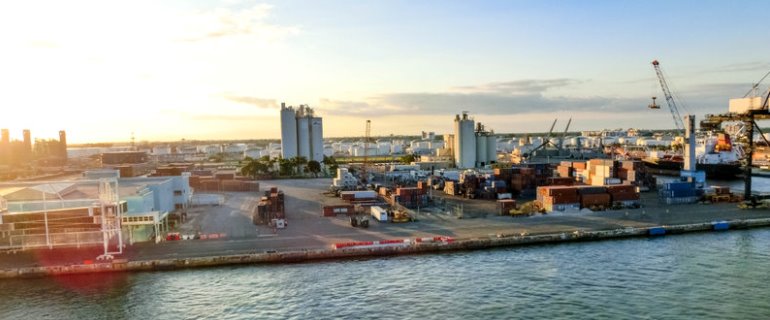
Some of that traffic is already diverting to Florida, with shippers calculating that the two-week detour from the west coast, through the Panama Canal and into one of Florida’s 15 deepwater ports makes more sense than lingering at sea for an extra month or two. Not all of Florida’s ports can handle the biggest container ships, but Port Tampa Bay, Port Everglades, Port Miami, Port Manatee and North Florida’s JAXPORT are already seeing increases in various types of cargo including bulk materials, automobiles along with the standard 20-foot containers used to bring consumer products from manufacturers in China, India and other foreign manufacturers. That’s a welcome change from 2020 when port activity dropped by a significant 16 percent, the Florida News Service reported.

That traffic augments Florida’s long-held position as cruise capital of the world. The cruise industry is still in recovery mode, but once the pandemic threat fades it should send traffic at the state’s ports (particularly Port Miami, Port Everglades and Port Canaveral, the world’s three busiest cruise ports) surging once again.

There are reasons Florida ports haven’t been as attractive to importers. Along with the obvious geographical challenges, there’s a lack of infrastructure needed to support a more robust flow of cargo. And Florida leaders must recognize that ports are only one part of the picture. The state’s ground transportation network must be robust enough to handle the flow of inbound cargo — and while lawmakers don’t need to revive an ill-conceived and costly scheme to construct “roads to nowhere” that cut across largely vacant land, they should plan on improving the state’s most important arteries for truck traffic, along with augmenting the rail system to move cargo, vehicles and materials quickly and cleanly.

There’s one more clear priority: As Florida pushes to expand its ports, it must set the national standard for environmental stewardship. While shipping and distribution support an estimated 900,000 jobs in the state, that number is dwarfed by the 1.7 million jobs generated by Florida’s tourism and hospitality industry. Florida already has a lot of damage to repair, particularly in the sensitive Indian River Lagoon. The state shouldn’t risk more degradation when it could instead lead the way in responsible port expansion.

Still, Florida leaders are right to see the snarled shipping situation in the nation’s biggest ports as a golden opportunity. Lawmakers are ready to invest in port infrastructure, adding to hundreds of millions in federal funding Florida ports have already received. In his budget outline, DeSantis requested $117 million for port improvements, and the House and Senate appear ready to top that – their preliminary plans include nearly $136 million for ports. In a year where Florida has plenty of money to spend — including the one-time deluge of cash from Washington — these investments in the state’s economic future make sense.


Source: Orlando SunSentinel

shipping-containers_9925505_s-770x320-1.jpg

South Florida’s industrial market fundamentals, particularly for bulk warehouse space, blew through the third quarter of 2021 on strong leasing demand and new construction

The region’s healthy consumer market and growing population helped push investor and occupier confidence in the industrial market, which is likely to continue through 2022.

The backlog at West Coast ports is causing weeks of delays for goods that need  to travel to East Coast markets, making warehouse/distribution space in South Florida an attractive and faster alternative from a distribution standpoint. Bottlenecks in the supply chain are realigning how many firms view real estate needs locally with a shift in philosophy for inventory management.

Previously, companies focused on lean supply chains where materials and goods arrive “just in time.” In a market like South Florida, that meant limited amounts of warehouse space were needed.  Now, companies are turning to an inventory strategy that follows a “just in case” model, where more goods are stored closer to customers to minimize fluctuations in demand. South Florida, with three deep-water ports, has the capacity to address the immediate logistics needs for companies with changing inventory strategies.

In the last year, 18,200 new industrial and warehouse-related jobs were created in Miami-Dade, Broward and Palm Beach counties. They were added because of big-box expansion by e-commerce firms, together with a push into last-mile facilities. Hiring also occurred with traditional retailers, plus new-to-market entrants, which increasingly viewed the tri-county as a strategic location to serve the immediate needs of customers.

New inventory and aggressive development captured some of the new employment. In the first nine months of 2021, 5.4 million square feet of new industrial space was delivered in the region. As the industrial inventory and deliveries grew, so did the occupiers’ space requirements for square footage, but new construction could not keep up.

As of the end of the third quarter, 6.6 million square feet of industrial space was under construction, with three projects representing 1.8 million square feet of new inventory. Still, overall industrial vacancy in South Florida fell to 4.4 percent in the third quarter. Both Miami-Dade and Palm Beach County were even tighter at 3.3 percent, with Broward County coming in at 5.9 percent as available space throughout the region decreased year-over-year.

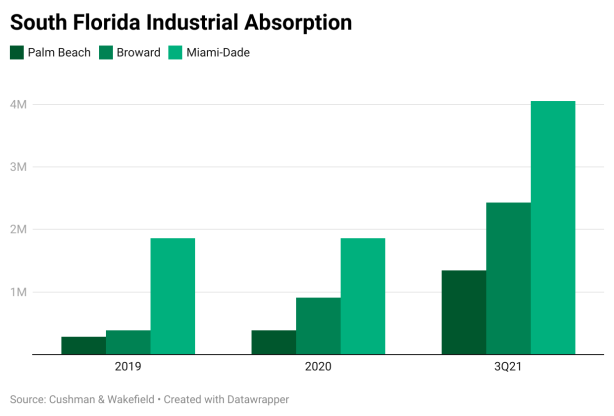
While not a record-setting year yet, new leasing activity year-to-date of 11.6 million square feet was only 18 percent less than the full amount for all deals done in 2019. Net absorption, or the amount of space absorbed by tenants, was 7.8 million square feet in 2021. That represents a 250 percent increase in the amount of space absorbed when compared to 2020.

yc37i south florida industrial absorption The South Florida Answer to West Coast Logistic Bottlenecks

In Miami-Dade, leasing reached more than 6.8 million square feet year-to-date, an increase of 15.5 percent compared to the same period one year ago. For that same period, Broward County recorded more than 3.6 million square feet, a 36.1 percent rise from 2020. Palm Beach County had 1.0 million square feet in new leasing activity so far in 2021.

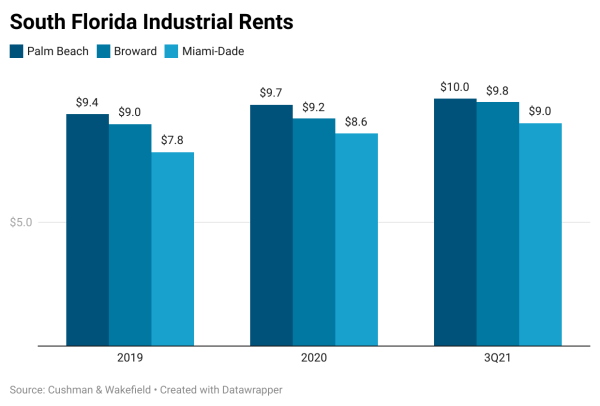
Limited availability on heightened demand allowed landlords to push asking rates to all-time highs. Overall average asking rents for all South Florida were at $9.87 per square feet, triple net, the highest amount recorded. Rents in Miami-Dade were at $9.17 per square foot, a 7.1 percent jump from last year. And Broward County also reached an all-time high of $10.27 per square foot in the third quarter. Palm Beach County topped out at $11.07 per square foot with the asking rate rising steadily over the last three quarters as construction picked up.

AfGHE south florida industrial rents e1637699131823 The South Florida Answer to West Coast Logistic Bottlenecks

Confidence in South Florida’s economy and potential for growth will only be enhanced by the lifting of U.S. restrictions on foreign travel. The influx of travelers and investors from overseas, starting over the holidays, will contribute to additional optimism in industrial market fundamentals in the region. The longer that challenges remain at West Coast ports to efficiently move goods into the United States means that South Florida becomes the better, more reliable strategic alternative for companies. The region’s positive fundamentals post pandemic,including solid population growth and rising incomes, make South Florida an attractive market for investment.


Source: Commercial Observer


amazon warehouse

Amazon is opening a 250,000-square-foot warehouse facility in Coral Springs to serve as a “last-mile” distribution center for the city and surrounding communities, according to Coral Springs officials.

The new center will provide 200 full-time jobs. It will be in the city’s Commerce Park, leasing space in the Exeter Property Group facility.

Amazon also purchased $3.5 million property in the south end of the corporate park to be used for truck parking and employee parking.

“Business expansion and job creation are essential to the growth and vibrancy of the City of Coral Springs and the reason we are excited to welcome Amazon to our Commerce Park,” Coral Springs Mayor Scott Brook said in a statement. “The creation of 200 full-time, diverse jobs in a post-pandemic climate is the boost we needed to jump start a stronger economy long term.”

Amazon has been expanding operations across South Florida as part of its efforts to get products faster to customers. In Tamarac, the global e-commerce giant is opening a same-day fulfillment center in the city’s industrial zone with the goal of delivering items to customers within about five hours, city officials said.

Brook added: “Their move to the newly built 250,000 square foot warehouse facility, is a strong signal to other large employers and industry leaders the benefits of our city’s location to the Sawgrass Expressway and connectivity to neighboring communities.”

Brook credited Greater Fort Lauderdale Alliance in working with city staff to help bring Amazon to Coral Springs.

It’s not clear yet when the new facility will open. Amazon could not be reached for comment.

Source: TapInto